
The Contagion
How the Algorithm Turned Every Person Into a Fame-Chaser and Buried Small Businesses in an Endless Sea of Noise

You opened the receipt. You saw the damage: 44,400 hours stolen from one life. One creator. One business owner who believed the promise. But that was just the personal toll.
Now look wider. The same slot machine didn't just hook individuals—it infected society. The platforms didn't stop at creators or businesses. They turned everyone into a content machine, chasing the same dopamine hit we were sold as "growth." And in the process, they drowned the very exposure small businesses once paid for in an ocean of endless, desperate noise.
This is the contagion. Act II of the horror story.
The Promise That Spread Like a Virus
In the beginning, it was simple: Platforms offered businesses a megaphone. Pay a little, reach thousands. Post your work, your story, your offer—and real customers would see it.
Then they opened the doors to everyone.
"Be an influencer!" the feeds whispered. "Share your life. Your breakfast. Your workout. Your hot take. Your dance. Your grief. Your glow-up." Suddenly, fame wasn't for the few—it was democratized. Anyone could be seen. Anyone could go viral. Anyone could build a following, monetize, escape the 9-5.
Billions answered the call.
Teens filmed themselves crying for sympathy likes. Parents staged perfect family moments. Employees turned side hustles into personal brands. Every phone became a studio. Every human a broadcaster.

The result? An explosion of content unlike anything in history.
In 2010, YouTube uploads were measured in thousands per day. By 2025? Over 500 hours of video uploaded every minute. Instagram? Billions of stories daily. TikTok? A firehose of short-form desperation.
Everyone chasing the same scarce resource: attention.
The Abyss Forms: From Opportunity to Mud
What happens when 8 billion people compete for the same finite eyeballs? The signal drowns in noise.

Business posts—once visible to followers—now compete not just with other businesses, but with:
Your neighbor's vacation reel
A stranger's political rant
A teenager's dance trend
An influencer's perfectly filtered life
Endless thirst traps, outrage bait, and viral stunts
The algorithm, once a tool for discovery, became a gladiator arena. To win, you don't just post—you perform. You chase trends. You provoke. You expose more. You optimize for rage, lust, envy, FOMO.

Small businesses? We never stood a chance.
We paid for followers thinking we'd reach customers. Instead, those followers—real people—got flooded with a million distractions. Our offer? Buried under a thousand lives screaming "Look at me!"
The exposure we bought became worthless. The audience we built got hijacked by the platform's new stars: everyday people turned fame-chasers.
The Human Cost: A World of Performers, No Audience Left
This wasn't accidental. It was engineered.
Platforms rewarded the loudest, sexiest, angriest, most viral. They amplified performative lives—perfect bodies, luxury illusions, controversy loops—because those kept eyes glued.
The contagion spread:
Regular people became brands
Vulnerability became content
Privacy became a liability
Authenticity became a performance
We all started climbing the same ladder: more likes, more followers, more validation. Be hotter. Be funnier. Be richer. Be more outrageous. Be anything but ordinary. The abyss deepened. Mental health crumbled under comparison. Relationships strained under staged perfection. Kids grew up believing worth = visibility.

And small businesses? We became collateral damage in a war we didn't start.
Our quiet offers—honest work, real services, local value—drowned in the scream for attention.
The Business Reckoning: Exposure Became a Mirage
Remember when a Facebook page with 10,000 followers meant something?
Now it means almost nothing.
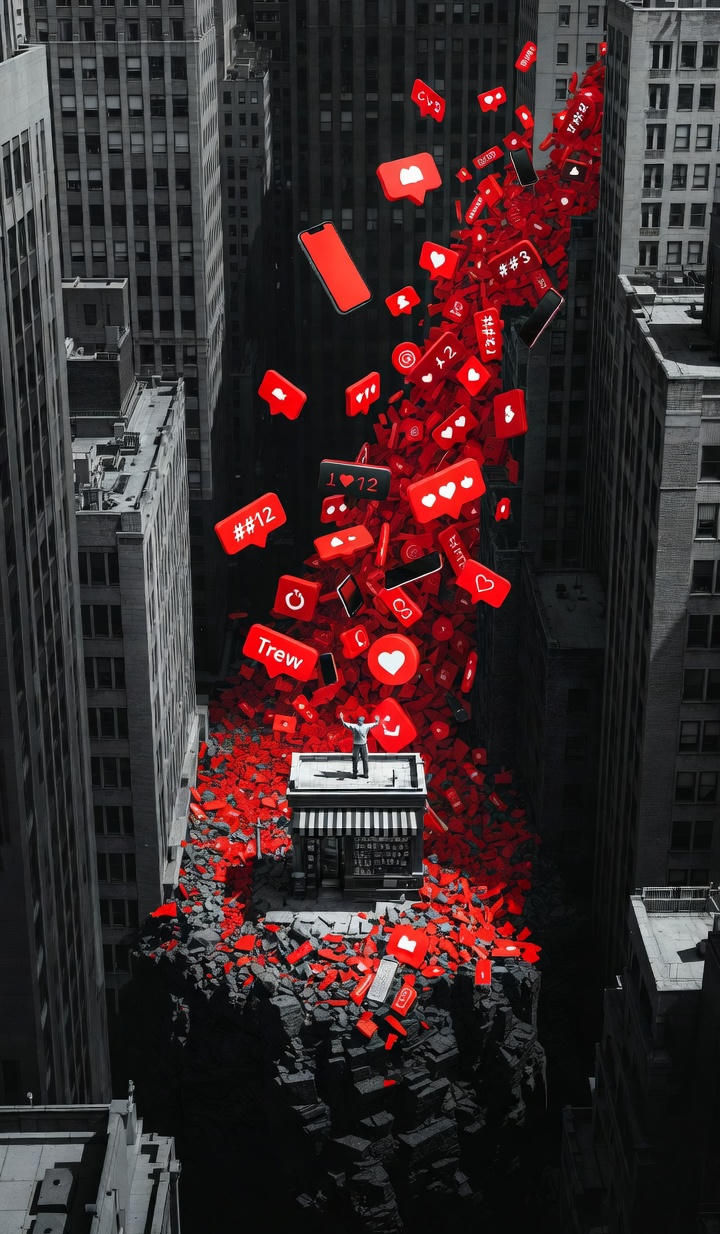
Your customers aren't ignoring you—they're drowning too. Their feeds? A tsunami of everyone else's "best life."
We paid to enter a theater. Then the platforms sold tickets to billions more performers. Now the stage is overcrowded, the audience exhausted, and the only way to be heard is to pay again—and again—and again.
This is the real theft: Not just your time. Not just your ad dollars.
They stole meaningful exposure and replaced it with noise.
They turned connection into competition.
They made fame the universal drug—and small businesses paid the tab.

The Way Out
At Bogdanov.com and Legend Ink, we're done performing for ghosts.
We're going back to what worked before the contagion: Real conversations. Real walk-ins. Real relationships built face-to-face, email by email, client by client.
We're not deleting our pages. We're leaving them as gravestones: "We no longer dwell here." The abyss is deep. But it's not bottomless. The cure isn't better content. It's less.
Fewer posts. Real places. Owned audiences.
Because in a world where everyone is shouting for attention, the quiet ones—the ones doing real work in the real world—are the ones who will be heard.

This is Act II.
Act III? Rebuilding outside the noise.
Stay tuned.
— Peter Bogdanov bogdanov.com
Footnote: The Hidden Cost of the Fame Economy
In the glittering rush for viral fame, society became hooked on a powerful new drug—one that promised endless validation through likes, shares, and followers. By 2025, an estimated 210 million people worldwide struggled with social media addiction, chasing dopamine hits from notifications and approval in a cycle that mirrored gambling more than connection (Addiction Help, 2025). Young people bore the heaviest burden: nearly 50% of teenagers reported feeling "addicted" to platforms, with many spending over 7 hours daily on screens, often at the expense of sleep, self-esteem, and real-world relationships (Common Sense Media; Statista). This collective craving turned fame into the universal narcotic, fueling an explosion of over 50 million content creators globally by the early 2020s, all vying for attention in an oversaturated digital arena (National Bureau of Economic Research, 2023).

Yet while millions chased the high, the rewards concentrated cruelly at the top. Platforms like YouTube paid creators reliably through ad revenue shares (often 55% to the creator), but TikTok and Instagram leaned on inconsistent funds and brand deals, where earnings skewed heavily toward mega-influencers—leaving most with pennies per thousand views (Epidemic Sound Creator Report, 2025; Influencer Marketing Hub). Engagement rates plummeted amid the noise, dropping on Instagram from 2.18% in 2021 to 1.59% by 2024, as algorithms buried organic reach and forced pay-to-play dynamics (Influencer Marketing Hub Benchmark Report, 2025). Small businesses, lured by promises of "free exposure" through influencer collaborations or viral posts, footed the bill: 93% faced common social media challenges like inconsistent results and high time costs, while many saw no direct sales lift despite heavy investment (Visual Objects Survey, 2021; ongoing trends in small business reports). In the end, the addiction enriched platforms and a tiny elite, while local shops and everyday dreamers paid the tab—bled dry by a mirage of reach that rarely turned into revenue.
