
Beneath Pacifica
Beneath Pacifica
How a Giant Pacific Octopus Turned an Aging Pump House Into a Gift to the City
On the Friday evening before Pacifica’s FogFest, Peter and Isaiah Bogdanov were still climbing ladders, mixing colors, stepping backward into the street to study the wall from a distance, and then moving forward again to make another adjustment. For three days, most of the Bogdanov family’s other business had been pushed aside so that the father-and-son artist team, joined by student artist Karter S., could make one final concentrated push on a mural that had already consumed weeks of thought, preparation, labor, politics, experimentation, and paint.
They worked until nearly seven o’clock that evening, exhausted but unwilling to leave the wall before it felt complete. At the end of the day, the Bogdanov name was placed on the mural, and a project that had begun as an aging municipal building in need of routine maintenance finally became Beneath Pacifica.

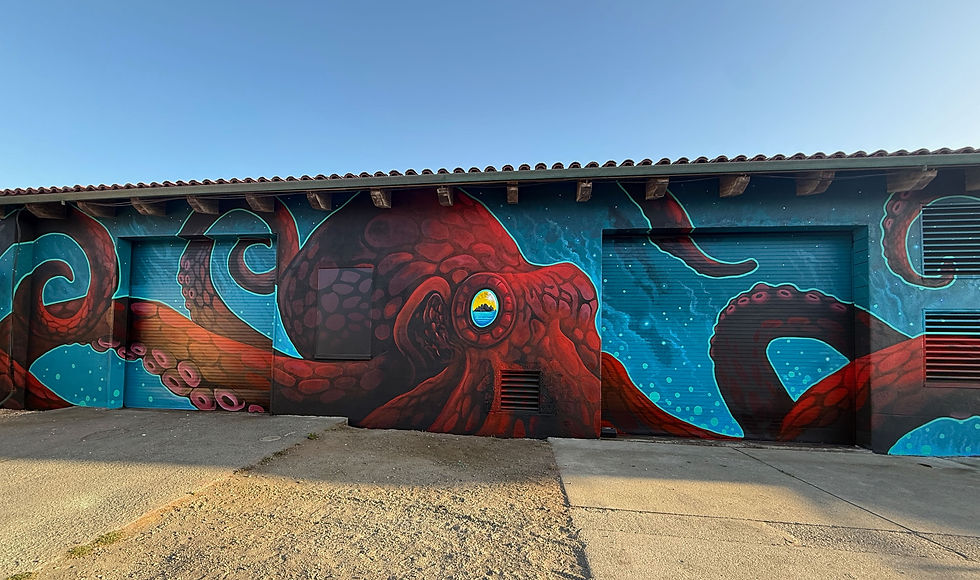
The finished mural stretches across roughly 100 feet of the City of Pacifica wastewater pump house, occupying approximately 1,500 square feet of architectural surface. A Giant Pacific Octopus moves across roll-up doors, vents, stucco, metal, plywood, pipes, architectural openings, and concrete surfaces as though the building itself has been swallowed by an underwater world. The animal is immense, red and dark, surrounded by turquoise water that gradually drifts into something more mysterious and cosmic. Tentacles curl around the architecture instead of pretending the architecture is not there. The building is not simply carrying a mural. It has become part of the mural.
That idea was present from the beginning. The original Beneath Pacifica proposal described the mural as an exploration of “the hidden world that exists just beyond the shoreline and beneath the city itself,” with the Giant Pacific Octopus connecting Pacifica’s coastal identity, marine ecology, public infrastructure, and the unseen systems operating beneath everyday life. Beneath Pacifica What eventually appeared on the wall went beyond the original digital concept, as original paintings should, but the central story remained exactly where it began: an enormous local marine creature emerging through the architecture of a working piece of Pacifica infrastructure.
A Paint Job Becomes an Opportunity
The mural exists because of a surprisingly practical conversation. Long before anyone was discussing octopus skin, cosmic clouds, pearlescent highlights, or giant tentacles, the pump house simply needed to be repaired and painted. The building contains important wastewater infrastructure serving Pacifica, but from the outside it had become an aging municipal structure that had gone a very long time without a serious exterior restoration. It needed patching, surface preparation, priming, and a proper paint system. The City already had a legitimate responsibility to maintain the building, and the question was how much more could be accomplished with that necessary work.

Peter Bogdanov approached Rey and Dan, who manage operations within Pacifica’s wastewater system, with a simple entrepreneurial idea: if the City was already going to spend money repairing and painting the building, what if that maintenance budget could become the foundation for something far more valuable? What if the City paid roughly what it would have paid for a quality conventional paint job, while the Bogdanov family donated the additional artistic time, design knowledge, mural labor, technical experience, and creative production necessary to turn the building into a major piece of public art?

Rey and Dan understood the opportunity immediately. They deserve to be regarded as two of the central figures in the story because ideas like this require people inside public institutions who are willing to recognize value when it appears in front of them. Peter could propose the structure, and the Bogdanov family could offer the artistic donation, but Rey and Dan were the people who understood that necessary maintenance could be transformed into something the public would actually cherish. The original proposal described exactly that partnership, crediting the City’s Public Works and Wastewater Division for recognizing the opportunity to transform required maintenance into a public artwork while the Bogdanov family contributed significant donated labor and creative value.
The economics were straightforward. Preparing and painting the building one ordinary color would have required a professional crew and several days of labor. Turning the same building into a major mural would require dramatically more time. Peter and Isaiah understood from the beginning that the mural would not make sense as a normal profit-driven commercial project. The Bogdanov family was prepared to donate as much as approximately $20,000 in additional time and services so that Pacifica could receive something far beyond an ordinary maintenance paint job. In practical terms, the family was taking the value already required to maintain public infrastructure and multiplying what the community would receive from it.
Before There Was an Octopus, There Was a Building to Save

The progress photographs are important because they prevent the finished mural from creating the illusion that the project began with artwork. It did not. The first phase looked far more like construction than painting. The old exterior showed decades of weather, salt air, surface damage, rusting metal, worn stucco, cracks, patched areas, and mismatched architectural materials. The artists were not working on a pristine wall specifically built for a mural. They were dealing with a functioning industrial building composed of a remarkable assortment of surfaces that all had to become one durable painting system.


The crew began by cleaning, repairing, patching, sanding, and stabilizing the surfaces. Stucco needed one kind of attention, metal doors another. Concrete repairs had to be handled differently from plywood, and old roll-up doors behaved differently again. Vents, louvers, pipes, door frames, patched stucco, textured wall surfaces, and metal elements all eventually needed to read as one continuous visual field. The original project plan called for site masking, power washing, stucco crack repair, surface preparation, metal preparation, bonding primer, and a complete wall-priming system precisely because the mural’s longevity depended upon what happened before the visible artwork began.
Beneath Pacifica
For a period of time, the building simply turned white. That stage may not have thrilled anyone looking for a giant octopus, but technically it was one of the most important moments in the project. The white primed surface exposed irregularities and allowed additional corrections to be made while creating a unified base across radically different materials. It was the quiet part of the work, the part that disappears completely once the mural is finished, but it is also the difference between painting something that photographs well for a year and building something intended to survive decades along the California coast.

Then, after all that work to make the building white, Peter and Isaiah did something that probably seemed peculiar to anyone watching from across the street: they painted nearly the entire building black.

The black was not an accident, nor was it simply a dramatic color choice. It was the visual foundation of the painting. It unified the building, created the darkest values needed for the octopus, and established the depth from which the rest of the mural could emerge. Suddenly the old municipal structure no longer looked neglected. Before a single recognizable tentacle appeared, the solid black building already had presence. People walking past could sense that something was happening, but there was no immediate explanation of what it would become. That suspense was intentional.
Painting as Performance
Peter and Isaiah do not approach large-scale murals as if the artist’s only responsibility is to reveal a finished picture at the end. Their method treats the entire period of creation as a form of public performance. A 100-foot mural does not appear in an afternoon. It develops over days and weeks, and during that time the same residents walk past it repeatedly. People take their dogs toward the beach, drive the same roads to work, walk children through the neighborhood, or pass the building on errands. The wall becomes part of their routine, and every major change becomes another act in an ongoing public event.

That philosophy shaped the entire construction of Beneath Pacifica. Instead of attempting to make every section look progressively “finished,” the Bogdanov team deliberately allowed the mural to pass through visually dramatic stages that were complete enough to be interesting but obviously capable of transforming again. The black building became one statement. The gray negative-space drawing became another. The red geometric skin became another. The turquoise background changed everything again. Later came water movement, bubbles, atmospheric elements, stars, cosmic forms, lighting effects, and more sophisticated surface modeling. A resident could pass the building on Monday and then return several days later to what felt like a different painting.

The first major reveal happened when gray negative space began moving across the black building. Rather than simply drawing the octopus in a conventional outline, Peter and Isaiah painted around the form. As the gray areas grew, the black silhouette that had been hidden in plain sight began to reveal itself. A curled tentacle appeared. Then another. Huge spirals formed. The head became visible. The architecture began to disappear into the composition, and for the first time the public could stand across the street and recognize the enormous creature stretching across the building.

The next stage added red, but even that was not done in the way most viewers might expect. The artists began constructing the octopus with repeated circles, ovals, and compressed elliptical forms. These shapes served a technical purpose. Painting a mural at this scale creates a strange visual problem because the artist is often standing only a foot or two from a form that may be twenty or thirty feet long. From across the street, the scale is obvious. Against the wall, it can become almost impossible to judge. The circle and ellipse system provided an underlying architecture that Peter and Isaiah could read at close range. Full circular shapes suggested surfaces facing the viewer, while narrower ellipses helped turn forms around the curvature of the tentacles. What looked temporarily like a graphic pattern was actually a structural language for building three-dimensional volume on a flat surface.
The photographs from this period now make the performance aspect unmistakable.

Pacifica was allowed to see the framework before it saw the finished illusion. The public watched geometry become anatomy. The red circles began merging into one another, darker shapes pushed underneath them, suction cups developed, the head became more dimensional, and the eye became a focal point. The octopus stopped looking like a diagram and began feeling increasingly alive. It was common for people to stop and tell the artists that they had thought the mural was already finished several days earlier, only to discover another transformation underway.

When the Wall Turned Blue
One of the most dramatic changes came when the gray background finally disappeared beneath turquoise and deep blue. Until that day, much of the mural still looked intentionally graphic, with the red-and-black octopus sitting against a cool neutral field. Then the Bogdanov team began painting the background, and within hours the entire emotional temperature of the building changed.
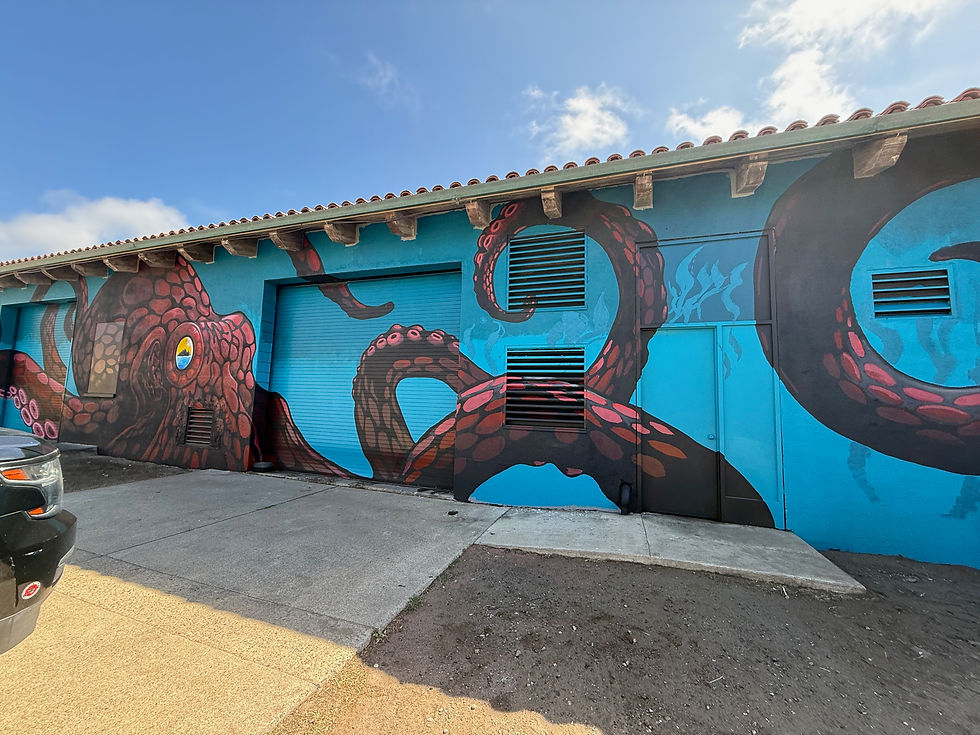
The turquoise caused the red octopus to move forward visually. The black values became richer. Tentacles that had previously existed as shapes began occupying space. Areas that looked like unfinished negative space suddenly read as water. The complementary relationship between the warm octopus and cool background energized the entire wall, and the mural became difficult to ignore even from a distance. That was one of the points when public excitement grew dramatically because people could see the transformation happen almost in real time.
The response from the community became part of the working day. Cars slowed. Drivers honked. People shouted encouragement through open windows. Parents stopped with children. Dog walkers crossed the street to get closer. Some residents who had previously passed the building weekly began deliberately walking by more often because they wanted to see what had changed. Peter and Isaiah sometimes found themselves spending fifteen minutes talking to strangers when they should have been painting, but those conversations were part of why the project mattered. The mural was no longer simply being made in public. Pacifica was participating in its creation by watching, reacting, questioning, photographing, sharing, and returning.
The variety of people responding to the mural was especially meaningful. Young children stared at it with the uncomplicated amazement children still possess before adults teach them to pretend not to be impressed. Younger residents stopped. Older residents stopped. Lifelong Pacificans stopped. People who had nothing obvious in common with one another found themselves talking about the same wall. Public art can become burdened with so much institutional language that people forget its simplest purpose: it can give strangers something to enjoy together. Beneath Pacifica was doing exactly that.
The Part of the Story That Was Not Beautiful
There was, unfortunately, another current running through the project. While the public response was becoming overwhelmingly enthusiastic, the relationship with members of Pacifica’s BAC beautification committee became increasingly contentious. From Peter and Isaiah’s perspective, some members of the committee repeatedly reacted to incomplete stages of the mural as though they were finished decisions, and rather than bringing questions directly to the artists, concerns were often sent through Rey and Dan. This created an atmosphere in which each stage of the performance could generate another round of criticism from people who did not necessarily understand the technical or artistic reason that stage existed.
The problem was not disagreement itself. Anyone involved in public art should expect discussion, and anyone working on public property should accept appropriate oversight. The difficulty came when consultation began to feel like attempted direction of the artists’ technique, composition, and working process. The Bogdanov team had presented and received approval for a Giant Pacific Octopus interacting with the architecture of the pump house, but the proposal image was always a conceptual rendering rather than a promise that the final mural would be duplicated pixel for pixel. Peter and Isaiah were creating an original painting, not reproducing a printed billboard.
That distinction mattered enough that it had already been addressed in the project proposal. The document specifically stated that artistic direction, technique, and execution would remain under the guidance of the lead artists because the design, materials, preparation, durability, and visual storytelling had to operate as a unified professional process. Beneath Pacifica To the Bogdanov family, repeated attempts to dictate intermediate artistic choices crossed the boundary between legitimate civic review and trying to perform the artist’s job from the sidelines.
Eventually Peter, backed by Isaiah and supported by Rey and Dan, confronted the issue directly. The message was straightforward: questions could be answered and concerns could be heard, but the mural could not be redesigned by committee every time an unfinished stage made somebody uncomfortable. Peter and Isaiah were donating a substantial portion of the labor and creative value required to complete the project, and they were not willing to surrender professional artistic judgment to people who had no contractual responsibility for executing the wall.
The episode became even more frustrating because the negativity threatened consequences far beyond a few unpleasant emails. The original hope had been that this financial and artistic model might be used on additional Pacifica wastewater buildings. By converting necessary maintenance into the starting point for major public artwork, the City had stumbled onto an unusually efficient way of creating civic landmarks. Yet the bureaucracy surrounding Beneath Pacifica became exhausting enough that enthusiasm for repeating the process diminished. A committee organized around beautification had, in the experience of the people actually executing the project, come dangerously close to making an extraordinary beautification effort impossible.
But that is not the ending of the story, and it should not be mistaken for the center of the story. The BAC conflict represented only a handful of voices. Outside that argument, hundreds and eventually thousands of reactions, comments, photographs, online discussions, honks, conversations, and expressions of appreciation were telling a very different story. Rey and Dan continued standing behind the project. Peter and Isaiah continued painting. The wall continued improving. The public continued responding. Whatever political drama surrounded the process, the community itself was making its opinion increasingly clear.
From the Deep Ocean Into Something Larger
Once the Bogdanov team had established the turquoise background, another transformation began. What had originally been an underwater environment started developing into something less literal. Water movement and bubbles appeared in the lower areas, while darker atmospheric fields developed higher on the wall. Small points of light began reading like stars. The separation between ocean and outer space started to dissolve.
That evolution changed the scale of the entire painting. A large octopus underwater feels large because humans understand the approximate scale of the animal and the sea. An octopus surrounded by an environment that begins to resemble a universe becomes something else entirely. The animal moves from biology into mythology. It begins to feel less like a specimen and more like one of the creatures sailors might have imagined when telling stories about monsters beneath the surface of the Pacific.
That sense of mythology had always been present in the project. The Wastewater team originally liked the idea of a Kraken, but Peter knew that a literal sea monster would be harder to connect meaningfully to Pacifica’s public identity. The Giant Pacific Octopus offered a better answer. It is a real animal associated with the Pacific Coast, yet it possesses the scale, intelligence, strangeness, and physical presence that gives old Kraken stories their power. The original proposal described the species as intelligent, adaptive, mysterious, powerful, and deeply connected to Pacific coastal life.
The mural could therefore acknowledge folklore without abandoning the actual ecology of the place. There was another layer to the metaphor. Beneath the streets of Pacifica is an unseen network of pipes and infrastructure carrying water and wastewater through the city. The pump house itself extends into a complicated industrial system that most residents will never see. Those underground systems reach through Pacifica much like the arms of an octopus, converging in facilities responsible for keeping the city functioning. In that sense, the creature painted across the exterior is not merely marine wildlife. It is also an imaginative portrait of the unseen mechanical organism operating beneath Pacifica.
Three Days Before FogFest
As FogFest approached, the mural entered its final and most intense stage. Peter runs an art school, a tattoo studio, and design-build work throughout the region. Isaiah has his own professional responsibilities as an artist. Other clients and projects still existed, and unlike civic celebrations, invoices possess the irritating human habit of continuing to arrive regardless of artistic inspiration. Nevertheless, with only three days remaining before FogFest, Peter cleared the schedule and committed the Bogdanov team to finishing the mural at the level it deserved.
Peter, Isaiah, and Karter worked long days refining the wall. The background became more atmospheric. Water effects became richer. Stars and cosmic elements appeared. One tentacle seemed to interact with a fiery orange celestial form, while another area developed a luminous burst surrounded by cloud-like shapes. The skin of the octopus was refined with stronger highlights and shadows, and specialized paints introduced effects that changed depending on how the viewer moved past the wall.
Pearlescent and opalescent paints were particularly effective because they made some edge colors behave differently under changing light and viewing angles. A turquoise edge could shift toward a silvery brightness as a viewer walked along the mural. Blood-orange highlights were then placed selectively across areas of the red skin, creating a dramatic warm accent against the dominant turquoise field. Those effects were not arbitrary decoration. They came out of a sophisticated understanding of color relationships. A bright accent becomes powerful not because it covers half the wall, but because it is restrained and placed against a field that makes it appear more intense.
The result was an artwork that continued rewarding people as they moved closer. From across the street, the viewer saw an enormous octopus commanding the entire building. From a few feet away, smaller effects became visible: skin textures, changing paint surfaces, bubbles, edge lines, layered reds, atmospheric marks, suction cups, highlights, and the way the painting crossed from stucco onto metal and then continued without apologizing for the interruption. The building’s awkward industrial architecture had become one of the reasons the mural worked.
The Building Became Part of the Animal
The mural was always intended to interact with the pump house rather than conceal it. In the original proposal, the octopus was described as reaching across the architecture so that doors, windows, and other structural elements became part of the underwater world. Beneath Pacifica That principle became more important as the painting evolved.
Tentacles curl around vents and travel over roll-up doors. The octopus crosses surfaces that would normally interrupt an image. Door openings become spaces within the composition. Louvers sit inside tentacle forms. Pipes and industrial elements remain visible, but they no longer feel separate from the artwork. From the side of the building, the creature continues around corners and onto retaining structures, creating the impression that it is not contained by a rectangular canvas at all.
That is what separates site-specific mural work from simply enlarging an illustration. The architecture has to matter. A successful mural on a building this complicated cannot treat every vent, door, pipe, and change of material as an inconvenience. Those features have to become opportunities. Beneath Pacifica works because the octopus appears to inhabit the pump house rather than merely decorate its façade.
The Evening It Became Finished
By Friday evening, on the eve of FogFest, the major decisions had been made and the final refinements were coming to an end. Peter and Isaiah had spent three intense days climbing ladders, studying the mural from the street, adding color, correcting forms, and building the final visual relationships across a wall so large that no single standing position could reveal all of it at once. Lunch had become a brief interruption rather than an event. The energy came from knowing that thousands of people would be moving through Pacifica the following day and that the mural would finally meet the city as a finished work.
Near seven o’clock, exhausted and satisfied, the team stopped.
The Bogdanov signature went onto the wall.
At that moment Beneath Pacifica stopped being a proposal, a controversy, a maintenance project, a worksite, or an unfinished painting. It became a piece of Pacifica.
FogFest provided the perfect public introduction. People moving down from the parade and toward the pier encountered the mural in its finished form. Photographs appeared online. Facebook and Nextdoor filled with images and conversations. Residents who had been following the process finally saw where all those strange intermediate stages had been leading. The black wall, the gray shapes, the red circles, the turquoise field, the strange cosmic atmosphere, and all those days of ladders and paint suddenly made sense together.
The people had watched a painting become itself.
Why Pacifica Matters to the Bogdanov Family
For Peter and Isaiah, the significance of the mural goes far beyond adding another project to a portfolio. The Bogdanov family’s connection to Pacifica stretches across generations. Peter and his sister attended schools in Linda Mar, and Peter’s children graduated from Terra Nova High School. The family has lived, worked, studied, created businesses, raised children, and made art throughout the Bay Area for decades. Life and work have carried members of the family to Hawaii, Oregon, Florida, and other parts of California, but Pacifica and the San Francisco Bay Area remain woven into the family’s identity.
That history changes what it means to leave a large permanent work in the city. A commercial mural can be satisfying, but there is something different about creating a landmark in the place that helped raise your family. Peter and Isaiah were not simply painting for a client. They were leaving something behind in a community they know intimately.
Someday the mural may be older than some of the children who watched it being painted. Those children may drive past it with children of their own. Peter’s future grandchildren may walk toward the beach, look across the street at the Giant Pacific Octopus, and hear that their family painted it. That possibility is part of what makes public art worth the effort. A mural can become a piece of collective memory long after the people who painted it have put away the ladders.
What Lies Beneath
The title Beneath Pacifica was chosen carefully. On the most obvious level, it refers to the Pacific Ocean just beyond the city and to the marine world living beneath its surface. The Giant Pacific Octopus represents that world, an intelligent and mysterious animal connected to the coastline and to the mythology humans have always built around the sea.
But the title also refers to the infrastructure beneath Pacifica. Under the streets and buildings is an enormous hidden network that residents depend upon but rarely think about. Water moves. Wastewater moves. Pumps operate. Pipes converge. Infrastructure quietly performs the unglamorous work that allows a coastal city to exist. The octopus and its spreading arms became a visual metaphor for those invisible systems.
There is also a more human meaning beneath the surface of the project. The mural contains the story of people choosing generosity over routine. It contains Rey and Dan recognizing an opportunity. It contains Peter turning an ordinary maintenance contract into an idea with far greater civic value. It contains Isaiah painting alongside his father. It contains Karter learning on a wall at a scale few young artists ever experience. It contains disagreements and frustration. It contains thousands of moments when residents stopped, looked up, smiled, asked questions, took photographs, or simply wondered what would happen next.
All of that exists beneath the finished paint.
Pacifica Won
It would be easy to end the story by dwelling on the conflict with BAC because conflict is loud and bureaucracy leaves a long paper trail. But that would give the least important part of the experience too much power. A handful of difficult interactions do not define what happened on this wall.
What defines Beneath Pacifica is that people with conviction continued. Rey and Dan continued believing in the opportunity they had helped create. Peter and Isaiah continued defending the professional independence necessary to make good art. The Bogdanov family continued donating the time and creative value it had promised. Karter continued learning and working. Most importantly, the community continued showing up.
The contrast could not have been clearer. While a few people were concentrating on control, thousands of community reactions were concentrating on joy. While arguments were happening in email chains and meetings, children were standing on the sidewalk staring at a giant octopus. Drivers were honking. Residents were stopping to thank the artists. Neighbors were changing walking routes so they could see what had changed since yesterday. People were photographing the mural and sharing it with one another because they were proud that something like this existed in their city.
That is why the difficult part of the story ultimately has a positive ending.
The bureaucracy did not win.
Negativity did not win.
The mural survived the argument and became larger than it.
Pacifica won because Pacifica got the artwork. The community won because the public received something it could experience together. Rey and Dan won because the idea they believed in became real. Peter and Isaiah won because they were able to finish the work with the artistic integrity they had promised from the beginning.
And the Bogdanov family gained something that matters more than another commission. We were given an opportunity to leave a piece of ourselves in the city that helped shape our family.
For that, we are deeply grateful.
We thank the City of Pacifica for the opportunity.

We particularly thank Rey and Dan of Pacifica’s wastewater management team, without whose enthusiasm and persistence this project would never have happened. We thank every resident who stopped to talk, every driver who honked, every child who stared upward, every person who photographed the wall, and every Pacifican who followed the strange progression from white building to black wall, from gray silhouette to red geometry, from turquoise water to an octopus floating somewhere between the Pacific Ocean and the stars.
What we leave behind in this world becomes, in its own small way, a thank-you note for having been here.
Beneath Pacifica is ours.
And now it belongs to Pacifica.


